1. BACKGROUND
a. What is Sewage?
The term sewage specifically is the wastewater that comes from houses that contains human urine and feces as well the water from kitchen, bathroom, and laundry activities. These need to be treated before discharging into any water source.
b. Centralized vs. Decentralised treatment

There are generally two types of wastewater treatment systems which are centralized systems (one central treatment) and decentralized systems (several small treatment plants) both having their advantages and disadvantages. The various systems of treatment of centralized and decentralized systems includes:
Table: All types of Sewage Treatment System with its cost and application
The sewage treatment option used in Birgunj is centralized Waste Stabilization Pond (WSP). This system of sewage treatment advantages and disadvantages include:
| Costing Rank | Treatment System | More Common Application | Application Location |
|---|---|---|---|
| Lower | Waste Stabilization Pond (WSP) | Decentralized / Centralized | Birgunj-Nepal (Centralized), Rural or developing communities |
| Lower | Constructed Wetlands | Both Centralized & Decentralized | Arcata, California, USA (Centralized), |
| Lower | Rotating Biological Contactor (RBC) | Both Centralized & Decentralized | Agnita, Romania |
| Medium | Aerated Lagoons | Both Centralized & Decentralized | Brazil |
| Higher | Trickling Filter | Both Centralized & Decentralized | Michigan, USA |
| Higher | Activated Sludge Process (ASP) | Both Centralized & Decentralized | Guheswori, KTM (Centralized), London, UK (Centralized), Akron, Ohio, USA (Decentralized), Gatineau, Canada (Centralized) |
| Higher | Sequential Batch Reactor (SBR) | Both Centralized & Decentralized | Abu Dhabi, UAE |
| Higher | Membrane Bioreactors (MBR) | Centralized | Singapore |
Table: Waste Stabilization Pond (WSP) advantages and disadvantages
| Advantages | Disadvantages |
|---|---|
| Low cost to build and maintain | Requires large land area |
| Simple to operate | Long treatment time |
| Effective at removing pathogens | Potential for odors |
| Can handle high organic loads | Limited pollutant removal |
| Sustainable and environmentally friendly | Climate dependent |
2. How does it treat wastewater?
Waste stabilization pond (WSP) treats wastewater with a series of ponds, which can also be used individually. The series of ponds in order include:
| Pond Series | Pond Type | Oxygen Level | Treatment By | Key Functions |
| 1 | Anaerobic | No oxygen (bottom) | Anaerobic bacteria | Break down waste without oxygen, trap solids |
| 2 | Facultative | Oxygen (top), no oxygen (bottom) | Green Algae & bacteria | Remove nutrients, produce oxygen, settle solids |
| 3 | Aerobic / Maturation | Oxygen-rich | Aerobic bacteria | Finish cleaning, kill germs, make water safer |
These can be used in multiple combinations as shown in the figure below. The best combination for best as well as faster treatment is combination 4. But, combination 4 is more costly and requires a large land area. The combination in Birgunj STP uses combination no 2 ( Anaerobic and Facultative ponds, both 2 nos.), which requires less area and cost but a longer time to treat wastewater. Also, separate disinfection should be done to kill pathogens before discharging the treated wastewater.
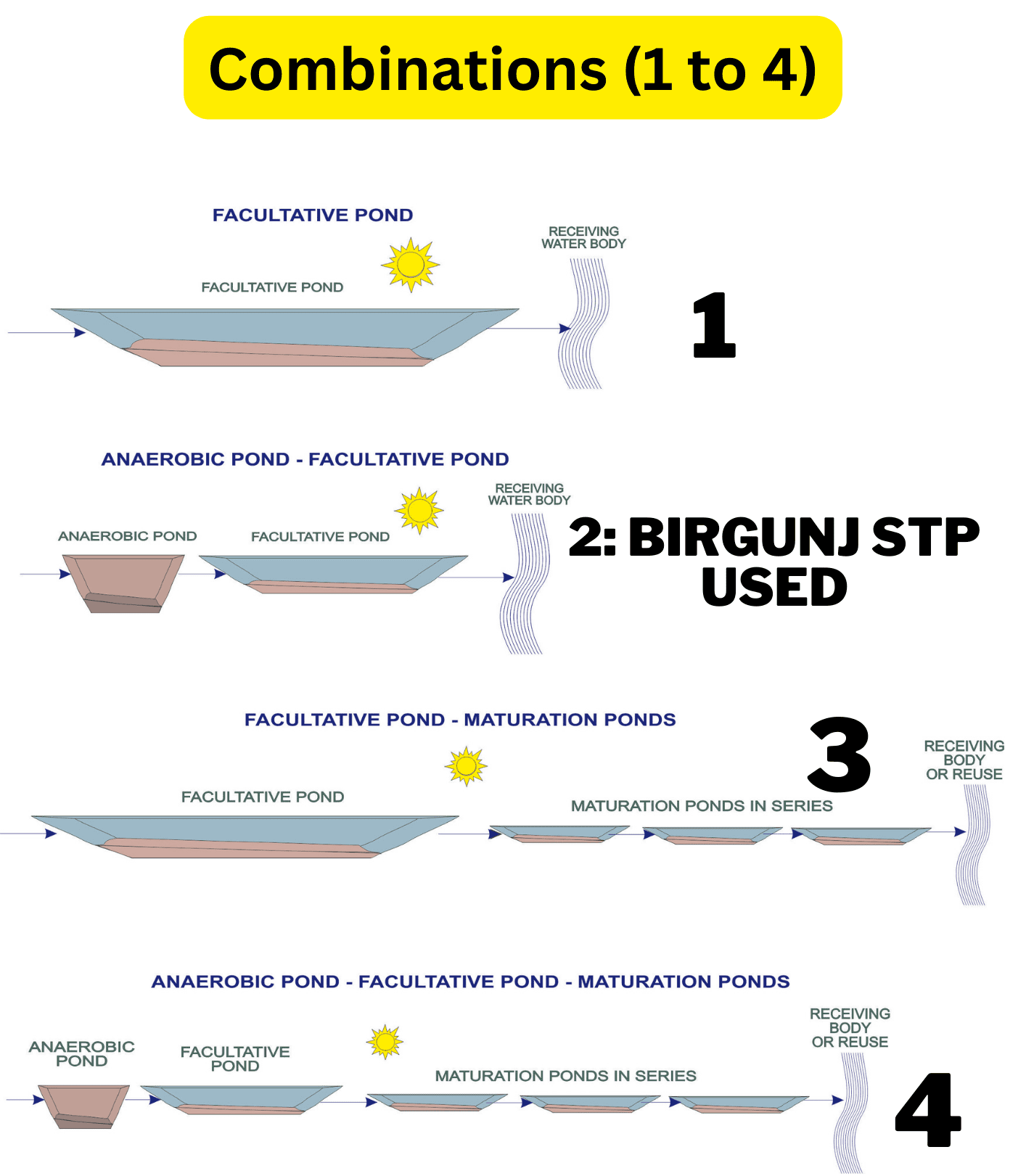
The pond is designed on specified depths and is designed on a specific range of detention time. In series, the detention time is the time of stay. In simple words, the wastewater remains in the anaerobic pond for 1-7 days, then the same water goes into the facultative pond for another 5-30 days. Then, goes into an aerobic pond for let’s say 10 days.
The total combined time ( if taken average) for full treatment becomes 4+18+5=27 days. If minimum time is taken for calculation then, the number of days is 1+4.5+3=8.5 days are required. Thus, from this, we can see that the wastewater needs to be kept on hold in the treatment plant for several weeks for full treatment. This explains why these WSP plants require so large area.
Table: Time for treatment in each pond in series
| Pond Type | Depth Range | Detention Time Range |
|---|---|---|
| Anaerobic Pond | 2 to 5 m | 1 to 7 days |
| Facultative Pond | 1 to 2.5 m | 5 to 30 days |
| Aerobic/Maturation Pond | 0.5 to 1.5 m | Varies (Less area – more time) (More area – less time) |
3. Birgunj Sewage Treatment Plant (WSP) design
| 1. Anaerobic Pond | |
| Feature | Value |
| Number of Ponds | 2 |
| Design Capacity in each pond | 5 MLD |
| Type | Rectangular |
| Detention Time | 1 Day |
| Dimensions | At Top: 59 m x 35 m x 4.5m ht + 0.5 m Free Board; (2065 Sq.meter) |
| At Bottom: 39m x 15 m (585 Sq.meter) | |
| Design Loading (Volumetric BOD loading) | 330 gram/m3/day |
| 2. Facultative Pond | |
| Feature | Value |
| Number of Ponds | 2 |
| Design Capacity in each pond | 5 MLD |
| Type | Rectangular |
| Detention Time | 4.5 Day |
| Dimensions | At Top: 204 m x 62.5 m x 2.0 m ht + 0.5 m Free Board (12,750 Sq.meter each) |
| At Bottom: 52.5m x 194m (10,185 Sq.meter) | |
| Design Loading (BOD surface Loading) | 322 kg/hectare/day |
3. Maturation Pond: Maturation pond is not provided as sufficient area is not available. It means that the pathogens are not killed. The chlorine disinfection is needed with bleaching powder addition. However, it has a high recurring cost of chemicals. Maturation ponds can be provided in the future if the required area is available. The design for maturation pond is as follows:
| 3. Maturation Pond (Not Provided) | |
| Feature | Value |
| Number of Ponds | 2 |
| Design Capacity in each pond | 5 MLD |
| Type | Rectangular |
| Detention Time | 3 Day |
| Dimensions | At Top: 205 m x 55 m x 1.5m LD + 0.5 m Free Board (11,275 Sq.meter each) |
| At Bottom 197 m x 47 m (9,259 Sq.meter) | |
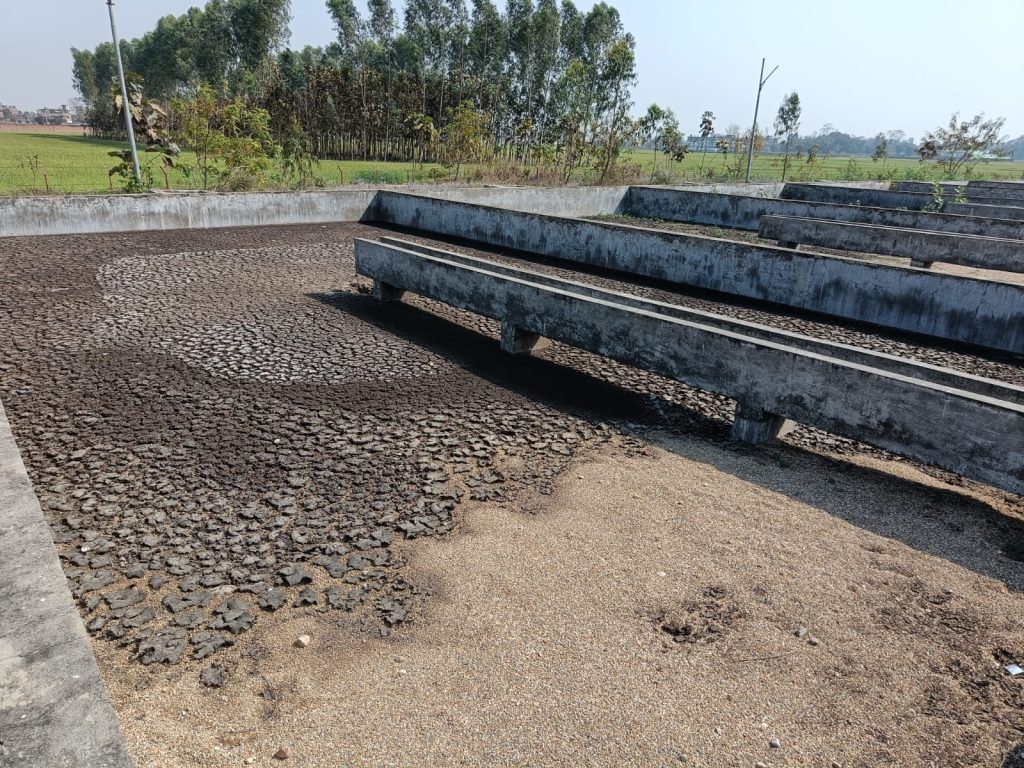
Figure: Sludge Drying Bed in Birgunj STP
4. Sludge Drying Beds: There is an accumulation of sludge in the anaerobic pond which needs to be cleared. This sludge cannot be thrown and needs to be dewatered and dried. This is done in sludge-drying beds. Basically, this comprises of stone and sand where a solid cake is formed after drying which can then be used as a fertilizer.
| 4. Sludge Drying Beds | |
| Specification | Value |
| No. of Sludge Drying Beds | 8 |
| Design thickness for sludge layer | 300mm |
| Feed Sludge Concentration | 8%-10% |
| Moisture in dewatered sludge | Approx. 40% |
| Size – Type | Rectangular |
| Detention Time | 2-3 weeks |
| Dimensions | 20 m x 11 m x 0.30 m sludge depth + 0.5 m Free Board (220 sq.meter each) |
WASTEWATER TREATMENT (IN and OUT water): As per Nepal Effluent Standards
Biological Oxygen Demand (5-day) reduction (BOD5):
- BOD5 entry from Household = 500 mg/liter
- Septic tank reduces 40 % BOD5
- BOD5 left to treat (60%) = 0.6*500 = 300 mg/liter
- After Treatment = 50 mg/l (released to water source)(83.3% Removal by STP)
Suspended Solid Reduction (SS):
- Initial SS from the household: 900mg/liter
- Septic tank reduces 50% SS
- Inlet Suspended Solid to STP (50%): 450 mg/liter
- Outlet Suspended solids: 100 mg/liter (78% removal by STP)
From above, it can be seen that the “SEPTIC TANK IS A MUST FOR ALL HOUSES” as the BOD is reduced by 40% and SS is reduced by 50% by the septic tank before reaching the sewage treatment plant. If the septic tank is not made, then there will be more load on the STP and the capacity will be insufficient.
In the initial years of operation, it will sustain the load but it will not operate with full design capacity for the design year. Hence, the misconception of not requiring a septic tank should be omitted.
OTHER COMPONENTS
The sewage treatment plant requires other components as well other than the pond itself and there is a series of steps taken. This includes:
| GOES FROM | GOES TO |
| 1. Inlet | Screen Chamber |
| 2. Sceen Chamber | Sump Well |
| 3. Sump well | Grit Chamber |
| 4. Grit Chamber | Parshall Flume |
| 5. Parshall Flume | Anaerobic Pond |
| 6. Anaerobic Pond | Facultative Pond |
| 7. Facultative Pond | Outlet (Main drain) |
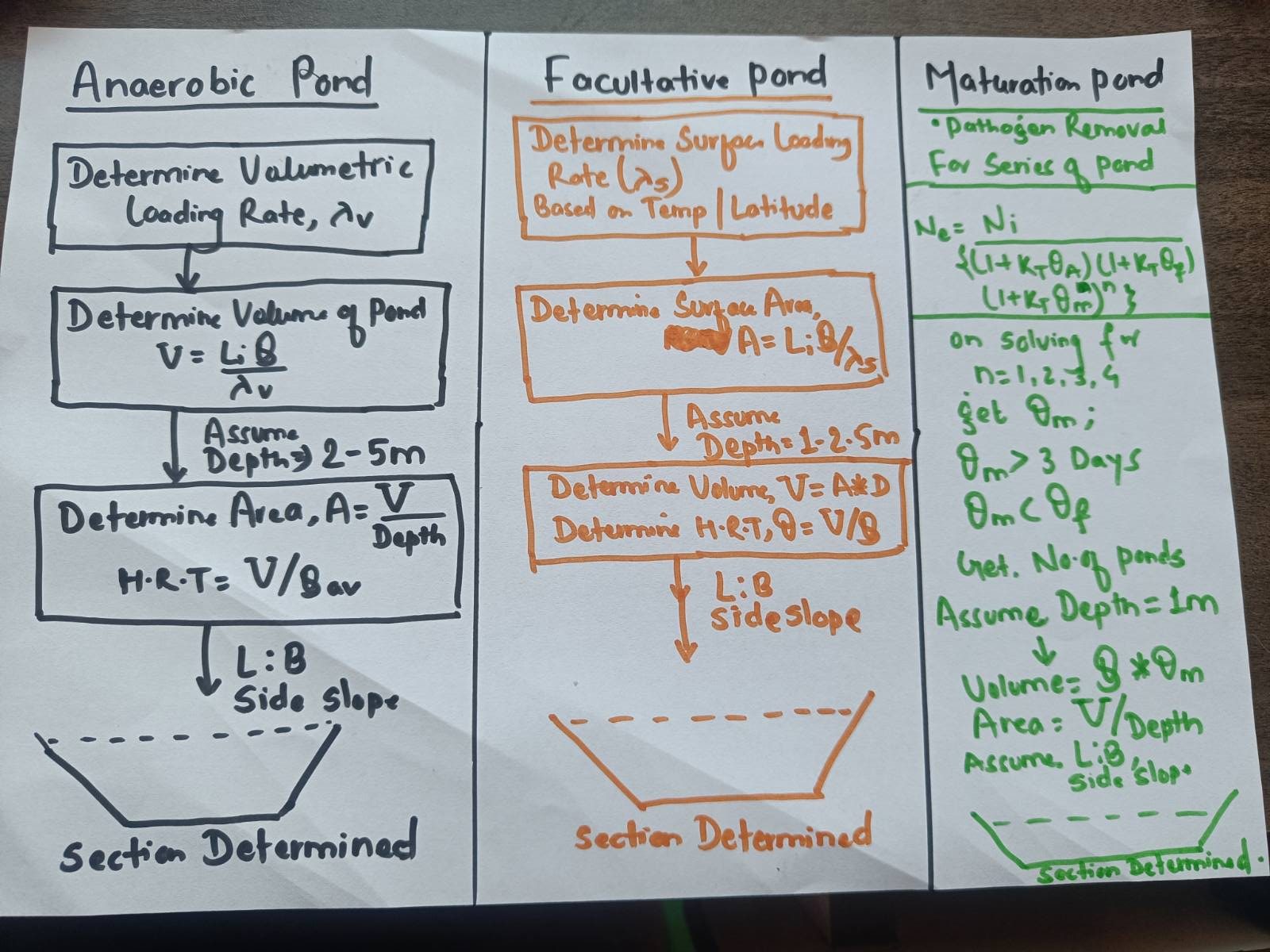
+++DESIGN YOURSELF WSP+++(ONLINE DESIGN)+++
YOU CAN ALSO DESIGN THE WASTE STABILIZATION POND. IT IS THE SIMPLEST ONE.
JUST TYPE THE BASIC WASTEWATER VOLUME AND GET THE AUTOMATIC DESIGN
**” Below is the design sheet, where you can enter values and design WSP “**
YouTube Video of How to Design WSP:
*Disclaimer: The author is not responsible for the professional or any use of this design sheet.

Rakesh Shah
Civil and Environmental Engineer
AUTHOR