What is Constructed Wetlands?
The constructed wetland is an engineered system that tries to mimic the natural wetlands. These are a simple technology designed to treat wastewater (domestic/industrial) and function not only to reduce the organics but also to efficiently remove chemical pollutants and nutrients like nitrogen and phosphorous and pathogens. The constructed wetlands are built in two configurations which are horizontal and vertical which combined use make hybrid constructed wetlands.
The direct wastewater cannot be fed to the constructed wetland and it needs some preliminary treatment (bar screen and grit chamber) as big particles can enter and clog the constructed wetland substrate. It is most used for the septic tank effluent, which can be directly fed to the constructed wetland as it is also a primary treatment and gives a good treatment efficiency.

Why Constructed Wetlands?
It has excellent wastewater treatment efficiency. Constructed wetlands are also simple to design and construct are versatile and can be made in horizontal, vertical, or hybrid systems. Also, it can be made to look beautiful with ornamental plants which differs from ugly-looking conventional wastewater treatment plants.
| Parameter | Removal Rate |
| Biological Oxygen Demand (BOD5) | 80-90% |
| Total Suspended Solids (TSS) | 90% |
| E.coli | 99% |
Constructed Wetland Components
Several components in constructed wetlands are required to make it fully functional. These are:
- Basin (Basically, a hole in the ground)
- Substrate (Gravel and sand media)
- Vegetation (Plants to absorb nutrients, many selection factors, most chosen Reed)
- Liner (to create an impermeable surface)
- Inlet and outlet arrangements (to regulate the flow of wastewater)
The components are designed to be placed so that wastewater flow can be horizontal or vertical. The constructed wetland (CW) where the horizontal flow of wastewater occurs is known as horizontal CW. The CW where the vertical flow of wastewater occurs is known as vertical CW. These have their advantages and disadvantages.
Constructed wetland design principle
The constructed wetland is designed on the principle of the first-order decay of BOD and also can be designed for total nitrogen. In simple terms, the microbes reduce the BOD in an exponential order which is known as first-order decay. The BOD decay formula is used and the equation is derived. The equation is:
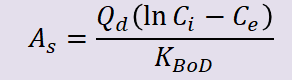
Where,
- As is the surface area of the bed
- Qd is the average wastewater discharge
- Ci is the BOD5 of influent wastewater
- Ce is the BOD5 of the effluent wastewater
- Kbod is a rate constant (m/day)

Solving, this equation gives the surface area required for both the horizontal and vertical CW. This equation is temperature dependent and Kbod needs to be adjusted for temperature. The constructed wetland can also be designed on other models rather than the first-order BOD model like the regression models and the empirical models. However, the first-order BOD is the most used model for the CW design.
Physical, chemical as well as biological processes together works to treat the wastewater in constructed wetland. The contaminant removal mechanism is:
| Contaminant | Removal Mechanism |
| Suspended Solids | Sedimentation and Filtration |
| Soluble Organics | Aerobic and Anaerobic Digestion by Microbes |
| Nitrogen | Nitrification and Denitrification by Bacteria |
| Phosphorous | Nutrient Uptake by Plants |
| Dissolved Metals/Heavy Metals | Physical (Adsorption), Chemical (Precipitation), Biological (Microbial Oxidation, Plant Uptake) |
| Pathogens | Filtration, Natural Decay and Predation, UV Kill, Antibiotics Release from Plant Roots |
Horizontal and Vertical Constructed Wetlands
- Oxygen Content: The horizontal constructed wetland has low oxygen in the media bed and the condition mostly remains anaerobic. However, in vertical constructed wetland with intermittent wastewater, good air is entrapped in the bed making it mostly aerobic. Good nitrification is also obtained by microbes in vertical CW due to the greater oxygen presence.
- Area Requirement: The area requirement is also less in the case of vertical CW and the main issue of the constructed wetland is its large area requirement. Hence, vertical constructed wetland are becoming a preferred choice.
- Bed Depth: The bed depth of Vertical CW can be up to 1 meter, whereas the horizontal CW has a lower bed depth. UN-Habitat recommends the use of a bed depth of 40cm for horizontal CW. Whereas, UN-Habitat recommends a vertical CW, a depth of 70m for adequate nitrification and pollutant removal (source).
- Media Substrate: Both fine and coarse particles can create problems and should be taken as:
Horizontal CW: Inlet and outlet:40-80mm diameter gravel, Bed zone: 5 to 20 mm graded gravel
Vertical CW: This requires a more detailed design. The uniformity coefficients should be looked at and should be well-graded. UN-Habitat recommends using sand 0-4mm as the main substrate and d10>0.3mm, d60/d10<4. For simplicity, the suggestion from the design figure can also be taken.

The best design of Constructed Wetland
Research has shown that a hybrid-constructed wetland is the best option. Then vertical flow CW is preferred due to its lower area requirement than horizontal flow. However, configuration can be of any type (source).
CAUTION
- Larger width beds are not preferred as short-circuiting (mixing) of wastewater can occur. Generally, a maximum of 15 meters width can be taken without partition. After that partition needs to be done or multiple beds need to be designed.
- The outlet needs to be controlled so that the water head is made retention time is controlled and a uniform discharge can be obtained.
EXCEL DESIGN OF THE CONSTRUCTED WETLAND
- Input the pretreatment data (can be skipped)
- Input the wastewater average discharge, In-Out BOD5 (others are typical values)
- Get the design and automatic drawing
Trick to design Hybrid Constructed wetland
- First design the constructed wetland (Taking BODin and Desired BOD out-at one stage)
- Second, design from the start of BODout and take End BODout to design and draw hybrid CW system.
Interactive Design and Drawing of Constructed Wetland (Refresh webpage for Original Values)
GOOD MATERIALS TO READ FURTHER:
- UN-Habitat Manual
- Research Paper: Performance Evaluation of Reed Bed CW
- Review Paper: Review of Constructed Wetland
Rakesh Shah (Civil and Environmental Engineer)
Author