The first step of any water supply from a source or wastewater treatment is screening. This protects the entry of large objectionable objects like logs, branches, rags, and even fishes. This is present in all water supply and wastewater systems. Also, this needs to be designed with proper guidelines. Let’s see the design of the bar screen and its chamber.
Types of Bar Screen:
- Coarse Screen: 50-100mm center to center
- Medium Screen: 20-50 mm center to center
- Fine Screen: less than 20mm, mostly 6mm wire mesh (clogged often and often not used)
Let’s see the complete design process:
- Design of Approach Channel
Usually, this is designed with the famous Mannings equation
Q = 1/n * A * R^(2/3) * S^(1/2)
- Q = Peak Discharge
- N = Mannings coefficient
- R = Hydraulic Radius
- A = Area of channel
- S= Slope of Channel
The channel can be designed as a rectangular, trapezoidal, or circular channel.
2. Design of Bar structure
The bar structure has to be designed with
- Bar size
- Number of bars
- Length of the bars
- Spacing of bars
- Layout of screen
3. Head loss calculations
There are losses induced in the system, which need to be calculated. There are formulas available with which the head loss can be easily calculated. These are:
- Krischmer’s Formula
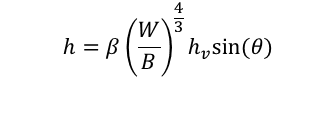
- Orifice Formula

Now comes the process of design: I have provided an easy online design sheet where you can type the design data and get the design and drawing, all linked by formula.
Generally, the bar screen is designed with two cases:
Design Case I: When reference flow velocity through the bar screen is fixed and the depth of the channel is fixed.
Design Case II: Design based on Fixed-size approach channel (or Existing channel)
…………………………………………………………………………………….………………………………………………………….
Design Case I: Velocity through screen and depth are known.
- Step 1: Assume velocity through bar, bar dimensions, clear bar spacing, etc.
- Step 2: Calculate the clear area (using Q =A/V)
- Step 3: Calculate clear spacing, number of bars, and chamber width.
- Step 4: Calculate the length of the bar
- Step 5: Calculate the approach velocity and area of the channel
- Step 6: Calculate head loss
- Step 7: Calculate the screen at 50% clogged condition for cleaning
- Step 8: GET AUTOMATIC SUMMARY AND DRAWINGS
Case I: Online Design Sheet (CLICK)
…………………………………………………………………………………….………………………………………………………….
Design Case II: Design based on Fixed-size approach channel (or Existing channel)
- Step 1: Design of approach channel using Manning’s formula
- Step 2: Calculate the number of bars and the length of the bar
- Step 3: Calculate head loss
- Step 4: Calculate head loss in 50% clogged condition
- Step 5: GET AUTOMATIC DESIGN SUMMAR AND DRAWINGS
Case II: Online Design Sheet (CLICK)
CLICK ON THE VIDEO TO FIND OUT MORE ABOUT DESIGN CASE I AND CASE II

Rakesh Shah
Civil and Environmental Engineer
AUTHOR