INTRO
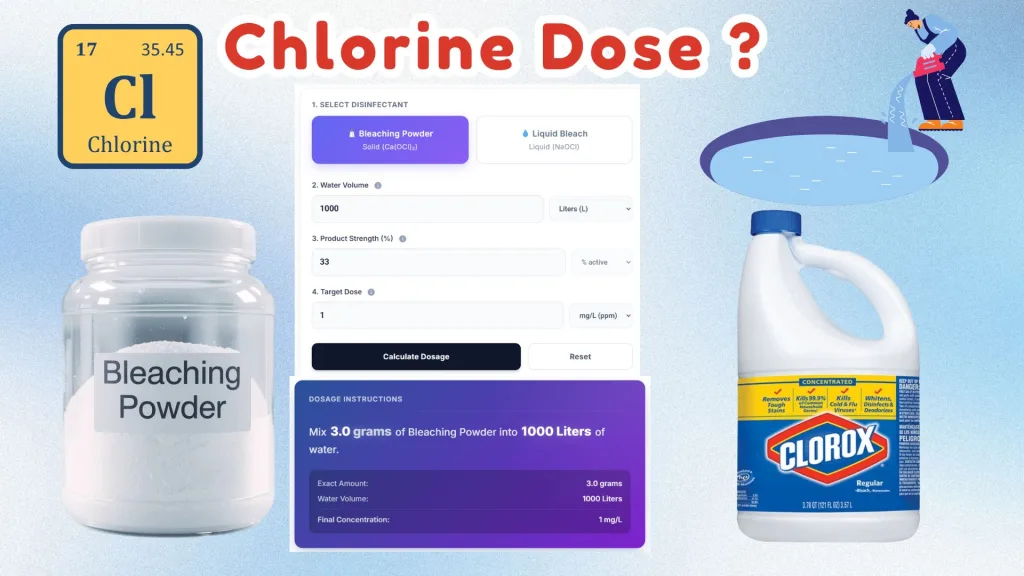
Chlorine is a powerful chemical used for cleaning, disinfecting, and bleaching. But chlorine gas is dangerous and hard to store. That’s why we use safer forms like bleaching powder and liquid bleach, which contain chlorine in stable compounds.
Let’s explore how these two forms of bleach compare in terms of composition, use, cost, strength, and more.
1. Chemical Composition
Bleaching Powder is mostly Calcium Hypochlorite (Ca(OCl)₂). It also contains calcium chloride and unreacted lime (calcium hydroxide)
Liquid Bleach, on the other hand, is Sodium Hypochlorite (NaOCl or NaClO) dissolved in water.

Both release chlorine-based compounds that disinfect and bleach surfaces. But they are different chemicals with different properties.
2. How Are They Made?
Both start from chlorine gas, usually produced by saltwater electrolysis (NaCl + H₂O).


3. Chlorine Content (Strength)
| Property | Liquid Bleach (NaOCl) | Bleaching Powder (Ca(OCl)₂) |
|---|---|---|
| Available Chlorine | 5–12% (Source (1)(2)) | ~35% (Source) |
| Strength | Weaker | Much Stronger |
Bleaching powder contains more chlorine per gram and is more concentrated, which makes it useful for industrial and emergency uses.

4. Stability and Shelf Life
Liquid Bleach is less stable. It breaks down in light, heat, or when exposed to air. It usually lasts only a few months. Bleaching Powder is more stable when dry and can last over a year if stored properly. It should be kept in a cool, dry, and dark place to prevent chlorine loss.
5. Solubility and Use
Liquid Bleach is fully dissolved in water and ready to use. Bleaching Powder needs to be dissolved before use, and it doesn’t dissolve completely. The leftover lime can make water cloudy and hard.
6. Cost Comparison
Liquid Bleach is cheaper to produce and is often used in homes. Bleaching Powder is more expensive per kilogram but more concentrated, so a small amount goes a long way.
7. Non-Chlorine Bleaches
Some bleach products don’t use chlorine at all. Common non-chlorine bleaches include Hydrogen Peroxide and Sodium Percarbonate (used in oxygen bleaches).
These are safer for colored clothes and the environment, but are milder in action.
8. Bleaching powder vs liquid Bleach decomposition
Bleaching Powder Decomposition
When bleaching powder gets wet, it slowly loses chlorine. Moisture and heat break down the active ingredient, making it less effective. That’s why proper dry storage is crucial.
Reaction with Moisture: Bleaching powder reacts with moisture in air, which produces chlorine gas that escapes into the air (Source).
2Ca(OCl)₂ + 4H₂O → 2Ca(OH)₂ + 4HOCl
4HOCl → 2H₂O + 2Cl₂↑ + O₂↑
Reaction with Carbon dioxide: Bleaching powder reacts with carbon dioxide in the air, thus releasing chlorine gas into the air and reducing its available chlorine content.
Ca(OCl)₂ + CO₂ → CaCO₃ + Cl₂↑
Decomposition with Heat: Bleaching powder decomposes under heat.
CaOCl₂ → CaCl₂ + O₂
Liquid Bleach Decomposition
Thermal Decomposition: 3NaOCl → 2NaCl + NaClO₃
Decomposition with Carbon dioxide: 2NaOCl + CO₂ + H₂O → 2HOCl + Na₂CO₃ , Then, 2HOCl → 2HCl + O₂↑
9. Toxicity of chlorine
The odor threshold for chlorine is 0.5-2 milligrams per liter, whereas LD50 (Oral-rat) is 850 mg/Kg (Source). Taking this, a 70 kg person will have to consume 59.5 grams of chlorine to have a 50% probability of death in the specified period.
Note: LD50, or lethal dose 50, is a measure of the acute toxicity of a substance, when given to a group of test animals, will kill 50% of that group within a specified period.
10. Summary Table
| Property | Sodium Hypochlorite (Liquid Bleach) | Calcium Hypochlorite (Bleaching Powder) |
|---|---|---|
| Physical Form | Liquid | Powder |
| Strength | 5–12% Chlorine | ~35% Chlorine |
| Stability | Less stable | More stable when dry |
| Solubility | Fully soluble | Partially soluble |
| Shelf Life | Few months | 1 year or more |
| Usage | Ready to use | Must dissolve first |
| Cost | Cheaper | More expensive |
| Common Use | Home cleaning, water disinfection | Pool chlorination, emergencies |
Conclusion
Both liquid bleach and bleaching powder are useful and effective. If you need a ready-to-use household cleaner, go for liquid bleach. If you need something stronger and longer-lasting, bleaching powder is a better choice if it can be properly stored.