Rakesh Shah*
* (Corresponding author), Department of Civil Engineering, Pulchowk Campus, IOE, Tribhuvan University, Nepal, E-mail: Rakesh.shah977@gmail.com
ABSTRACT
The study determined the factors contributing to hand pump failure in Birgunj, Nepal. This study focuses on limitations inherent to suction lift technology and the impact of seasonal groundwater fluctuations. An analysis of static groundwater observations identified significant fluctuations in groundwater levels during pre-monsoon and monsoon seasons. The findings reveal that static groundwater levels had approached or exceeded the hand pump’s maximum suction limits, leading to operational failures and water shortages in Birgunj. Establishing a reliable groundwater monitoring system is crucial and it is essential to consider practical/working suction limits, rather than maximum suction limits. This study underscores the critical need for measures to address hand pump failures and lays the groundwork for enhancing water security in Birgunj and similar regions.
Keywords: Hand pump, Hand pump failure, Groundwater fluctuations, Sustainability
INTRODUCTION
Access to clean water is crucial for human survival and development, especially in rural communities where hand pumps are often the primary groundwater extraction device. In Nepal, hand pumps are used as devices to extract groundwater in the southern Bhabhar zone and middle Terai (Pathak, 2016). This accounts for 90% of the water demand (Mukherjee, 2018) including Birgunj. Nepal experiences a monsoon season from June to September which comprises 80% of the annual precipitation (Gautam & Regmi, 2014). About one-third of the recharge is estimated to take place in the Chure-Bhabhar zone, with the rest occurring in the Terai plains (Pathak, 2016).
In Nepal, there are 1.2 million hand pumps that have been installed in the Terai region (SEIU-MWSS, 2016). Suction hand pumps work on the principle of suction which is limited to the atmospheric pressure. Hence, sustainability of this source of water is threatened by groundwater fluctuations, the loss of water recharge habitats, overexploitation of groundwater, and climate change. In Birgunj and surrounding locations, multiple hand pump failures occurred throughout the city, leading to a massive water shortage (Acharya, 2023). This paper evaluates the case of hand pump failure in correlation with groundwater table fluctuations and establishes the risk with the operation of the hand pump in Birgunj.
LITERATURE REVIEW
The suction-type hand pump works by creating a vacuum which draws water from the static water table to the surface with reciprocating movement as shown in Figure 1.

The theoretical limit that atmospheric pressure can push is 10 meters, whereas the practical limit is around 7-8 meters (Baumann, 2000)
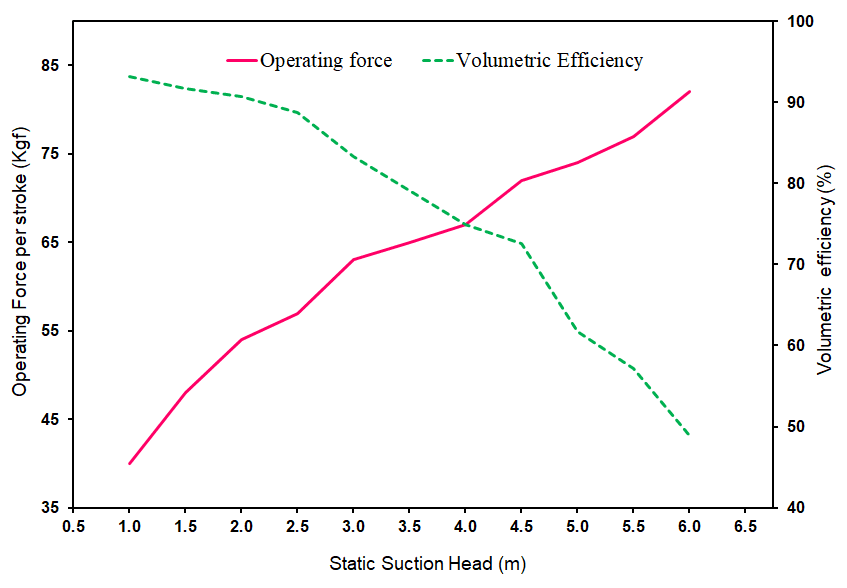
. There is variation in suggested suction limits. However, most propose a limit of 7 meters (22.97 feet) (Sarkar & Jha, 2015). The rise in the suction head also impacts the hand pump’s volumetric efficiency and operating effort as seen in Figure 2. This implies the negative side of working hand pumps at higher suction heads. (Sarkar & Jha, 2015).
The static water table in Birgunj was found to fluctuate and was found to be 8.35 meters (27.4 feet) below ground level in Birta, Birgunj (JICA, 2019) The static groundwater table (GWT) closely approached the specified maximum limit. This observation suggests that the static GWT in this area is very close to certain unknown limiting suction values, which are less than the theoretical atmospheric limit. Many areas in Birgunj lack water supply coverage (JICA, 2019). Thus, failure of hand pumps means failure to fulfill water adequately.
The length of the suction pipe significantly affects the suction limit of hand pumps, with longer pipes resulting in increased frictional losses. Increasing the length of the pipe reduces the suction limit due to the addition of frictional losses. For 80 meters of suction pipe length, the suction head up to which the hand pump works will reduce to half than for the short-length pipes (Fraenkel, 1986).
Various factors influence the creation of a perfect vacuum, including altitude pressure reduction, vapor pressure reduction, frictional losses, pump and aquifer properties, and dynamic drawdowns (Fraenkel, 1986) (Baumann, 2000) (Tackett et al., 2008). The altitude affects atmospheric pressure, with higher altitudes resulting in decreased suction limits. An altitude of 1500 meters above mean sea level leads to a decrease in the suction limit by around 1.5 meters, while at 3000 meters above mean sea level, there is a decrease of suction limit by around 3 meters (Fraenkel, 1986). Similarly, temperature variations also impact the suction limit, with a 7% reduction observed when temperatures rise from 20 to 30 degrees Celsius (Fraenkel, 1986).
This water-bearing aquifer in Birgunj consists of both confined and unconfined aquifers, as well as perched aquifers, whose static level may be at different levels from the ground surface (Pathak, 2016). The Terai region of Nepal, where Birgunj is situated, boasts abundant groundwater resources, particularly in highly transmissive aquifers with well yields ranging from 5 to 60 liters per second (Kansakar, 2005) (Shrestha et al., 2018). This supports the installation of a high number of hand pumps with minimal water drawdown (Arlosoroff et al., 1987).
In Birgunj, a common practice involves using suction hand pumps in combination with motors, which are connected to a single borehole as shown in Figure 3. This setup allows for the use of both manual hand pumps and motorized suction centrifugal pumps as needed. Centrifugal pumps (motor) have lower suction limits than reciprocating pumps (hand pumps) as centrifugal pumps are more prone to cavitation (Fraenkel, 1986).

However, several interrelated parameters affect both the suction limits and the yield for the manual suction hand pumps. Thus, the operation of hand pumps exhibits a dynamic nature influenced by multiple parameters. Mapping studies of groundwater table where identification of the most vulnerable area like conducted in Bangladesh (Mojid et al., 2019) will help better understand the situation. In Birgunj, Nepal, limited research has been conducted on hand pump sustainability, necessitating further investigation into this critical issue.
METHODOLOGY
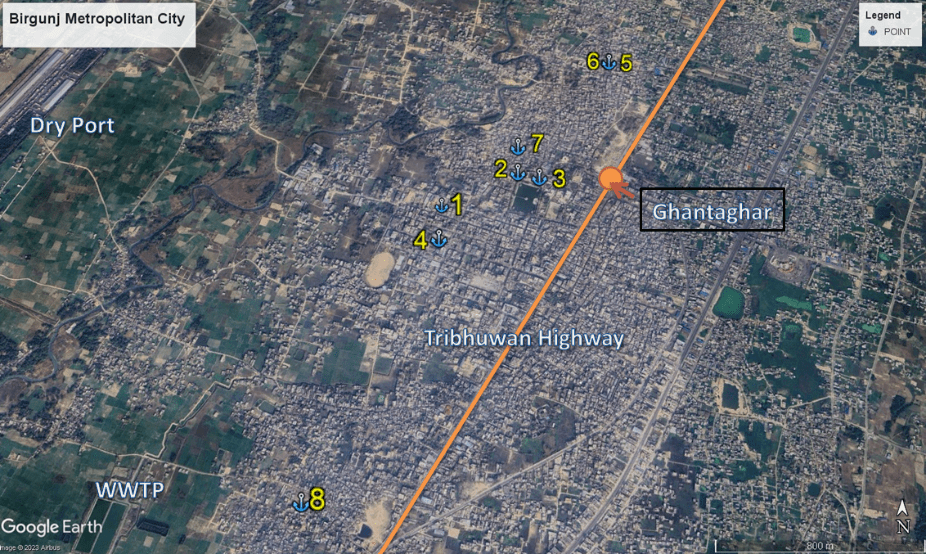
The methodology involved measuring of static water table at different locations in Birgunj. The observation was conducted to observe the fluctuation of groundwater. Static groundwater observations were conducted at multiple locations, with measurements taken at various intervals to assess seasonal fluctuations.
Locations where hand pumps were still in operating conditions were selected. The existing hand pump head was removed and the measurement was taken with the help of nylon string and a weight tied for hearing a resonating splash. The plots of the groundwater table were prepared to evaluate the scenario of the hand pump and compared it to its inherent suction limits.
RESULTS
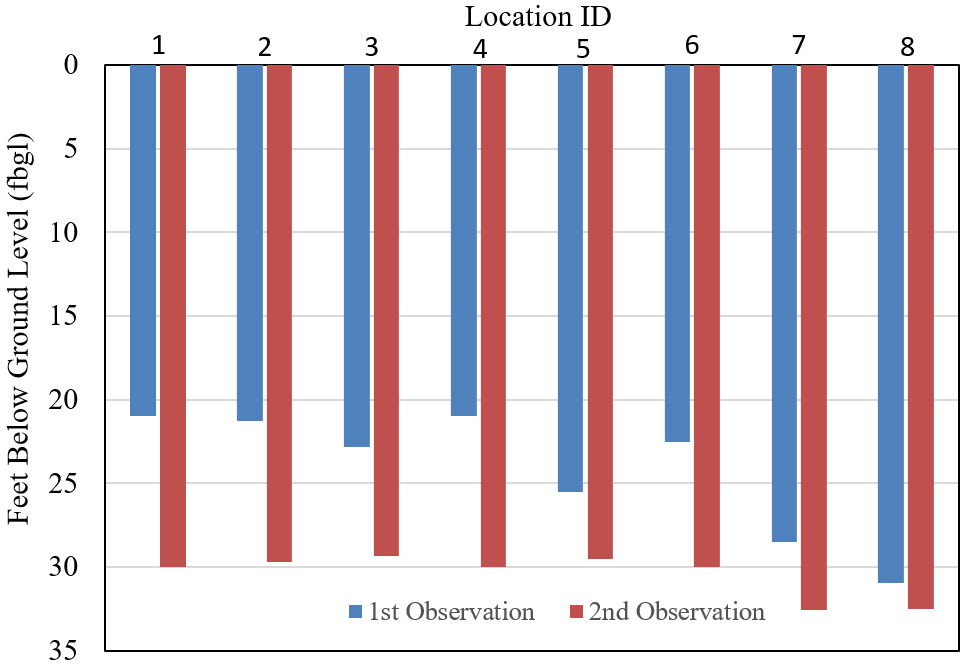
The groundwater fluctuation occurs in the pre-monsoon season as seen from Figure 5. The static groundwater table of the confined aquifer varied for location ID 1 to 8 (154 days gap) and also for Location ID 7 and 8 (94 days gap). The decrease in the groundwater table was seen as much as 9 feet within 154 days apart in February and July of 2023 in the pre-monsoon season. The hand pump was found to fail in suction at locations ID 7 and 8 for the second observation. At other locations also, the groundwater level was at critical levels in the second observation in July. It was observed that in locations where the hand pump failed, the suction centrifugal motor pumps also failed.
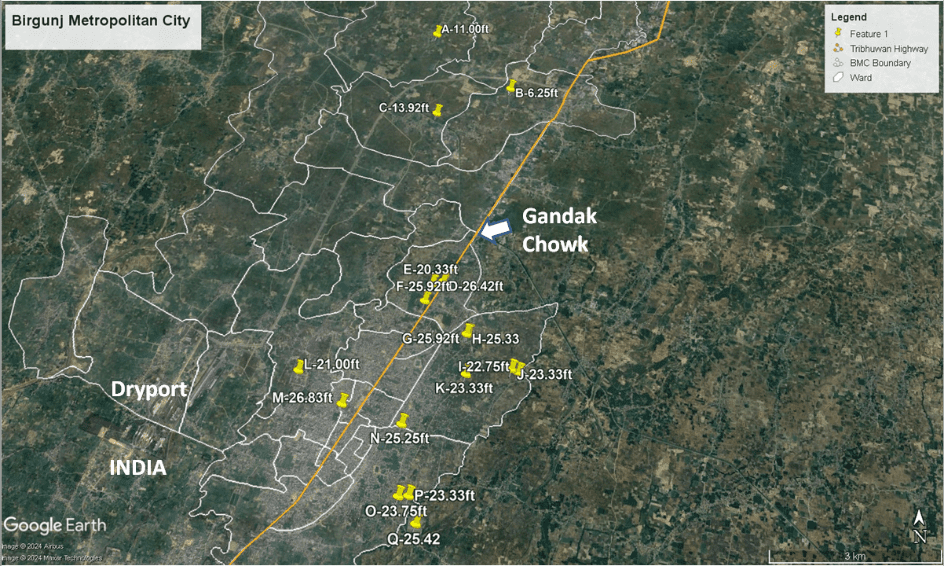
Another observation of static ground water table was made on 10th and 11th September 2023 covering 17 locations in the monsoon period. The water is extracted from the confined aquifers covering lengths of suction pipe from 131.33 feet to 240 feet. It can be seen from Figure 7 that the static ground water table varied from 6.25 feet to 26.83 feet.

DISCUSSION
Analysis of the data revealed significant fluctuations in groundwater levels in Birgunj, particularly during the pre-monsoon and monsoon seasons. Static groundwater levels were found to be near suction limits for hand pump operation, indicating potential challenges in maintaining a consistent water supply. Additionally, some hand pumps exceeded maximum suction limits, leading to the suction failure of hand pumps. Hand pumps were also found to have failed at many locations in Birgunj in the dry season in 2023 creating a panic situation with water shortage.
The observation in pre-monsoon showed a lower static groundwater table than the observation near the end of the monsoon season. The recharge of water is expected to have occurred which raised the static groundwater table. The findings suggest that groundwater fluctuations and the limitations of suction-type hand pumps contribute to hand pump failure in Birgunj which was seen in the study year. Additionally, due to poor drainage in the flat terrain of Birgunj, the newly constructed roads and houses are much elevated. This is also increasing the effective suction heads in city areas.
The inadequate monitoring systems exacerbate the problem, highlighting the need for measures to address these issues. The practical/working suction limits of the hand pump should be prioritized which will yield a higher volumetric efficiency. There is also a need to implement reliable monitoring systems and explore alternative water supply options to mitigate the impact of hand pump failures in Birgunj.
CONCLUSION
This study investigated hand pump failures in Birgunj, Nepal, revealing the limitations of the hand pumps. The suction technology has inherent limitations which create a restricted capacity for hand pumps limited by the suction limits. The static groundwater tables are at risk of exceeding the suction limit during the dry season. The lack of comprehensive groundwater monitoring in Birgunj hinders effective planning and management of water resources.
Hand pump failures pose significant challenges to water access and community well-being. By understanding the underlying causes of these failures and implementing proactive measures to address them, sustainable water access can be ensured for the residents of Birgunj. This case study underscores the importance of prioritizing practical suction limits and investing in robust monitoring systems to maintain the functionality of hand pumps and mitigate the impact of groundwater fluctuations on water supply. This study lays the groundwork for Birgunj’s future water security. Further research on aquifer properties and long-term groundwater table monitoring would improve predictions to make informed decisions.
REFERENCES
Acharya, S. (2023, 07 21). Lack of drinking water in Birganj. Retrieved 07 27, 2023, from ekantipur.com: https://ekantipur.com/pradesh-2/2023/07/21/168993982042566870.html?fbclid=IwAR3AYK3flRFJlMbYsUUpMGsbaCZpaOl-4hZ9hO1Xfm8cNyeW-GW99UELDj0
Arlosoroff, S., Tschannerl, G., Grey, D., Journey, W., Karp, A., Langenegger , O., & Roche, R. (1987). Community Water Supply: The Handpump Option. Washington, D.C.: The World Bank.
Baumann, E. (2000). Water Lifting. Series of Manuals of Drinking Water Supply, Volume 7, 4.
Doltade, A., Pandit, B., & Sarjerao, B. (2021, Dec 11). Novel hydrodynamic cavitation based hand pump for disinfection of groundwater. Retrieved Feb 26, 2023, from onlinelibrary.wiley.com: https://onlinelibrary.wiley.com/cms/asset/3819fb55-7c74-4e66-8154-af4dad37407f/tqem21832-fig-0001-m.jpg
Fraenkel, P. (1986). Water-Pumping Devices: A Handbook for Users and Choosers. Intermediate Technology Publications Ltd., London, UK.
Gautam, D. K., & Regmi, S. K. (2014). Recent Trends in the Onset and Withdrawal of Summer Monsoon over Nepal. Ecopersia, 353.
Google Earth. (2023, Nov 7). Satellite Image of Birgunj Metropolitan City [Digital Image]. 45R,. Retrieved Feb 25, 2023
JICA. (2019). Data Collection Survey on Water Supply and Waste Water Sector in Nepal,. Federal Democratic Republic of Nepal, Ministry of Water Supply.
Kansakar, D. R. (2005). Understanding Groundwater for Proper Utilization. Groundwater Research and Management: Integrating Science into Management Decisions (p. 95). Roorkee, India: International Water Management Institute.
Mojid, M. A., Parvez, M. F., Mainuddin, M., & Hodgson, G. (2019). Water Table Trend—A Sustainability Status of Groundwater Development in North-West Bangladesh. MDPI, 12.
Mukherjee, A. (2018). Overview of the Groundwater of South Asia. Groundwater of South Asia. Springer Hydrogeology. Springer, Singapore., 14.
Pathak, D. (2016). Water Availability and Hydrogeological Condition in the siwalik foothill of east Nepal. Nepal Journal of Science and Technology, 34.
Sarkar, A., & Jha, M. K. (2015). Performance evaluation of a hand pump with provision of a sealed secondary water sump. Agric Eng Int: CIGR Journal, 166-175.
SEIU-MWSS. (2016). Nepal Water Supply, Sanitation and Hygiene Sector Development Plan ( 2016 – 2030 ). Kathmandu.
Shrestha, S. R., Tripathi, G. N., & Laudari, D. (2018). Groundwater Resources of Nepal: An Overview. Groundwater of South Asia. Springer Hydrogeology. Springer, Singapore., 178.
Tackett, H. H., Cripe, J. A., & Dyson, G. (2008). “Positive Displacement Reciprocating Pump Fundamentals- Power and Direct Acting Types. Proceedings of the Twenty-Fourth International Pump Users Symposium, (pp. 45-58).
Wateraid. (2008, 06 05). Hand pumps. Retrieved Feb 25, 2023, from washmatters.wateraid.org: https://washmatters.wateraid.org/sites/g/files/jkxoof256/files/Technology%20notes.pdf
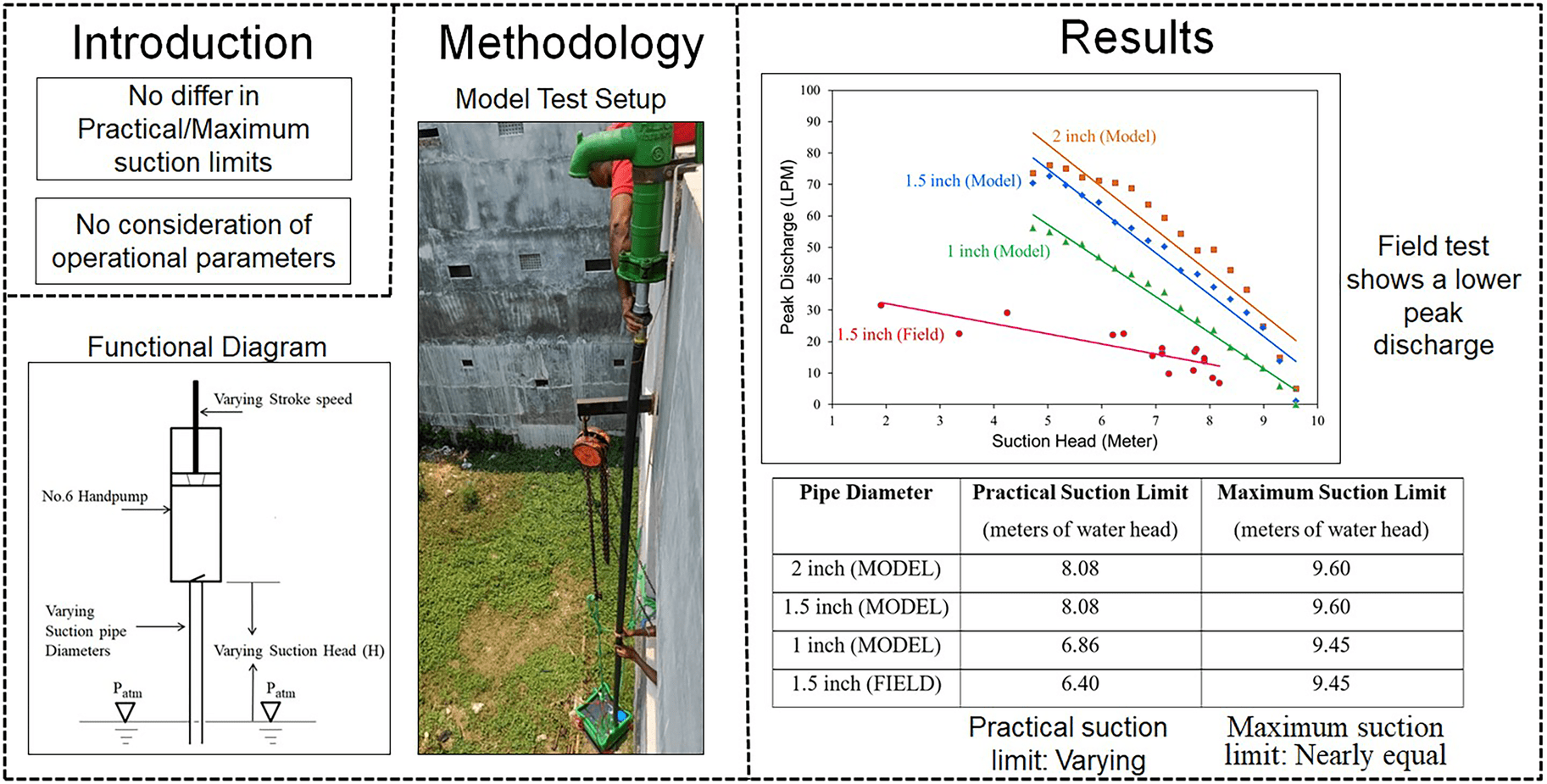
Also Look (Research Paper): Evaluating performance and suction limits of No.6 hand pumps with varying operational parameters
About this paper: This research paper studies the suction hand pump in Birgunj and tests for its suction limit and its operational efficiency.