The height of a chimney should be sufficient to release smoke safely into the atmosphere while complying with the environmental regulations of the country where it is located.
In this article, we provide a simple explanation of how to calculate the required chimney height, along with a basic calculation tool. By entering the necessary input values, you can easily determine the appropriate chimney height.
CLICK: EXCEL DESIGN SHEET (CALCULATE)
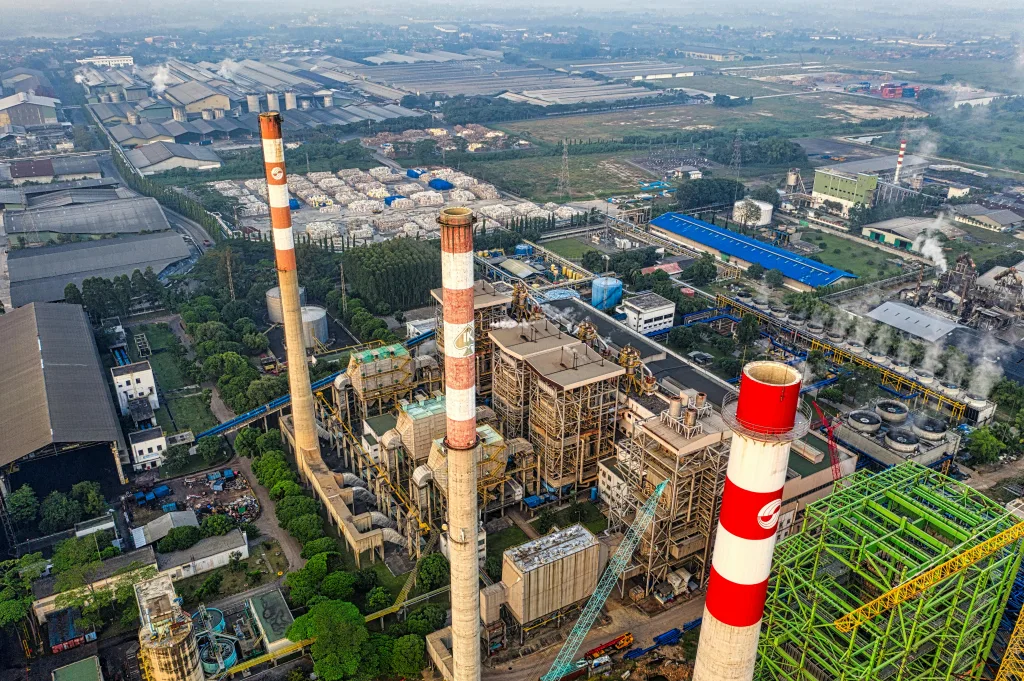
Emissions from chimneys include particulate matter (fine dust particles) and various gases such as sulfur oxides (SOx), nitrogen oxides (NOx), carbon oxides (COx), and others. It is essential to release these pollutants at a sufficient height to prevent an increase in local air pollution.
In India, the Indian Pollution Control Board (IPCB) specifies guidelines for the minimum height of chimneys or stacks. These guidelines primarily consider releasing particulate matter and sulfur dioxide (SO2) into the air. Since the concentrations of other gases like NOx and CO are generally lower than SO2, designing the chimney height based on SO2 emissions also ensures compliance with other pollutant gases.
The height of Chimney based on Particulate Matter emission: (SOURCE)
H = 74 (Qp) 0.27
- H = Chimney height in meters (m)
- Qp = Particulate matter emission rate in ton/hour
The height of Chimney based on SO2 emission (SOURCE)
H = 14 (Qs) 0.3
- H = Chimney height in meters (m)
- Qs = SO2 emission rate in kg/hour (kg/hr)
Other general guidelines are:
- A minimum of 30 meters or 90 feet in general for industries.
- Low capacity boilers generating steam less than 2 ton/hr., the minimum height of chimney is 9 meters and for greater than 30 ton/hr., the minimum is 30 meters and in range for medium capacity.
- For diesel generators, the height of the chimney should be more than the height of the nearest building and is given by the formula as, H = Building height + 0.2 x KVA capacity
- For Thermal power plants with a boiler size, of 200-500 MW capacity, the height is 220 meters and for plants greater than 500 MW, the height is 275 meters. Less than 200 MW, H=14 (Q)^0.3 is used for SO2 emissions.
The Central Board gives the above guidelines for the prevention and control of water pollution in 1984 AD as: “A Method to Determine the Minimum Stack Height“

Also, the results from this method are compared with the methods adopted in other nations and the results were summarized as:

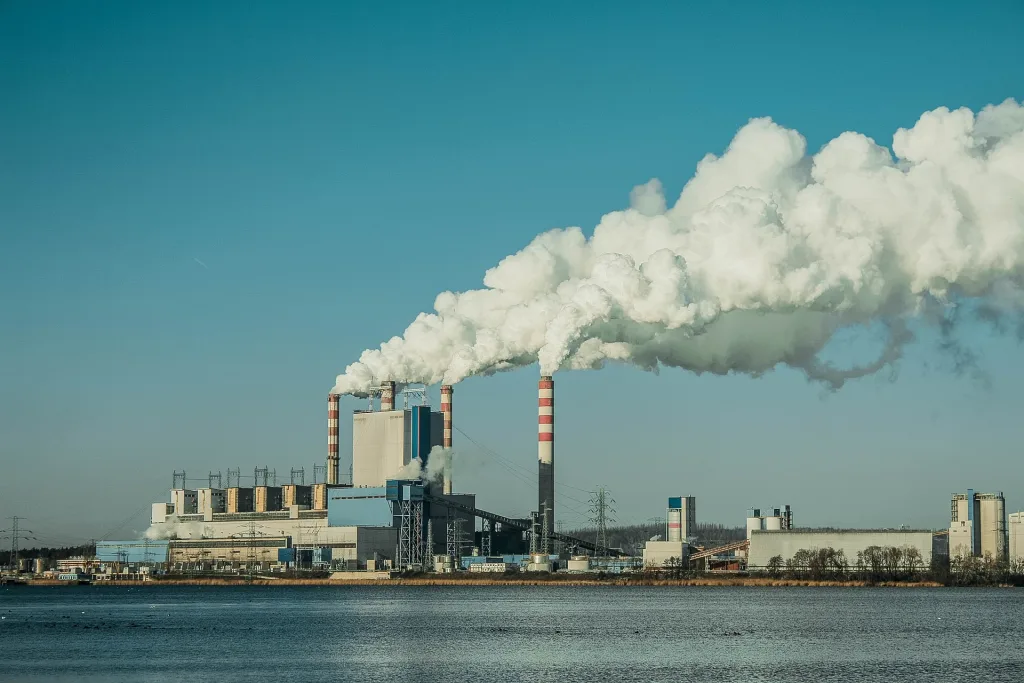
The chimney does work to disperse/diffuse into the air. However, the cumulative effects of air pollution are bad for the world and are aiding global warming and climate change.
….
Let’s look at some numerical examples for the calculation of Chimney/Stack height:
EXAMPLE 1:
A Factory uses 10,000 liters of oil per month as fuel. It is estimated that for every 1,00,000 liters of fuel burnt, the pollutants released are:
- Particulate matter = 2.9 ton
- SO2 = 60 ton
- NOx = 8 ton
- Hydrocarbon (HC) = 0.4 ton
- CO = 0.5 ton
What is the height of the chimney required for safe dispersion of air pollutants:
Solution:
Since, the design guidelines only takes consideration of particulate matter and SO2 , the chimney will also be designed for these only.
For Particulate matter:
Particulate matter released per month = 2.9/100000 * 10000 = 0.29 ton/month
Then, PM released per hour (Qp) = 0.29/(30*24) = 0.00040278 ton/hour
H = 74 (Qp)0.27 = = 74 (0.00040278)0.27 = 8.97 meter
Height of Chimney = 8.97 meters (for Particulate Matter)
For SO2 :
SO2 released per month = 60/100000 * 10000 = 6 ton/month
Then, SO2 released per hour = 6/(30*24) = 0.008333 ton/hour = 8.333 Kg/ hour
*Note that for SO2 , it is in Kg/hour in the formula.
H = 14 (Qs)0.3 = 14 (8.333)0.3 = 26.45 meter
Minimum Height of Chimney = 26.45 meter (for SO2 )
Hence, keep the minimum physical height of the chimney at ~ 27 meters for the effective disposal of air pollutants.

….
EXAMPLE 2:
An industry needs to burn 5.5 tonnes of fuel every hour. The coal has a sulfur content of 4.2 percent. The gases need to be released into the atmosphere through a chimney. What will be the minimum height of the chimney required?
Solution:
Emission rate of Sulphur = 5.5*1000*0.042 = 231 kg/hour
Sulfur in coal combines with oxygen to form SO2,
S ( 231Kg ) + O2 ( 231Kg ) ———–> SO2 (462Kg )
Emission rate of SO2 (Qs) = 462 Kg/hour
Minimum Height of Chimney required = 14 (Qs)0.3 = 14 (462)0.3 = 88.2 meters
Hence, the minimum height of the chimney required for the safe dispersion of pollutant gases is ~89 meters.
….
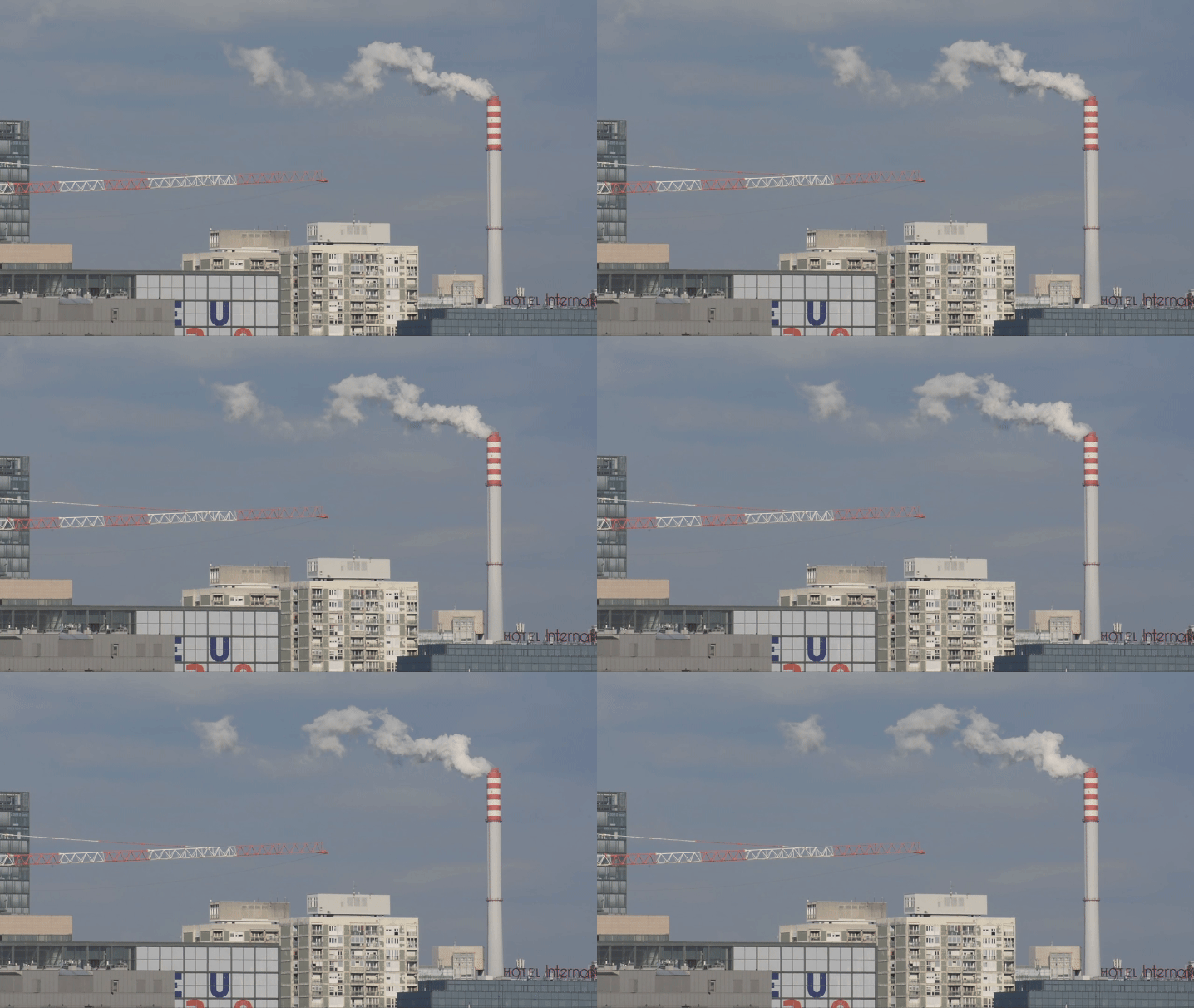
The physical height of the chimney is different from the effective height of the chimney. When the height of the plume/smoke is added to the physical height of the chimney, the effective height of the chimney is obtained.
Also Read: Calculate the Rise of Smoke from a Chimney (Part 2)
Also Read: Calculate Air Quality Near a Chimney (Part 3)

Frequently Asked Questions (FAQ)
1. What is the minimum chimney height required for industries in India?
For general industrial applications, the minimum chimney height is 30 meters (90 feet) [1]. However, this varies based on boiler capacity and fuel type.
2. How do I calculate chimney height for diesel generators?
The formula is H = Building height + 0.2 × √KVA [1, 2], where H is the total stack height in meters and KVA is the generator capacity.
3. What is the chimney height for low capacity boilers?
For boilers generating steam less than 2 ton/hr, the minimum chimney height is 9 meters. For boilers greater than 30 ton/hr, the minimum is 30 meters [1].
4. What formula is used for calculating chimney height based on SO₂ emissions?
For thermal power plants less than 200 MW, the formula H = 14(Q)^0.3 is used, where Q is the SO₂ emission rate in kg/hr [1].
5. How tall should chimneys be for thermal power plants?
For boilers with 200-500 MW capacity, the height is 220 meters, and for plants greater than 500 MW, the height is 275 meters [1].
6. What factors determine industrial chimney height?
Chimney height depends on fuel type, emission rates (particularly SO₂ and particulate matter), boiler capacity, and the height of nearby buildings. Environmental regulations also play a crucial role [4].
7. Why is chimney height important for air pollution control?
Chimney height ensures emissions are released at a sufficient altitude to prevent increases in local air pollution by dispersing pollutants over a wider area [1, 4].
8. What is the CPCB method for determining stack height?
The Central Pollution Control Board published guidelines in 1984 titled “A Method to Determine the Minimum Stack Height” which considers particulate matter and SO₂ emissions [1, 8].
9. Does fuel type affect chimney height calculation?
Yes. Natural gas emits very little particulate matter but significant SO₂, so stack height is designed based on SO₂ emissions [2]. Different fuels require different design considerations.
10. What is the stack height for a 500 KVA diesel generator?
Using the formula H = h + 0.2√KVA, for a 500 KVA generator: H = building height + 0.2√500 = building height + 4.47 meters [1, 2].
11. How does chimney draft relate to chimney height?
Draft developed by a chimney is directly proportional to its height – the taller the chimney, the greater the draft for proper venting of flue gases [7].
12. What are boiler chimney height regulations in India?
Industries must follow regulations under the Environment (Protection) Act, 1986, with stack heights calculated using formulas considering emission rates and dispersion factors [1, 8].
13. How is effective stack height different from physical height?
Effective stack height includes the physical chimney height plus the plume rise caused by the momentum and buoyancy of hot gases. This determines actual dispersion effectiveness [6].
14. What is the minimum stack height for medium capacity boilers?
For boilers in the medium capacity range (between 2 ton/hr and 30 ton/hr), the minimum height ranges from 9 meters to 30 meters depending on the specific capacity [1].
15. Can I use the same formula for all types of industrial processes?
No. Industrial processes that don’t burn fuels but emit gases or particulates require different calculation methods based on the specific pollutants and emission characteristics [2].
Sources:
- Central Pollution Control Board (CPCB), India – Environmental Standards for Ambient Air
- Ministry of Environment, Forest and Climate Change, Government of India
- Envitrans – Stack Height Calculator based on CPCB Guidelines
- Sapien Knows – Simple Height Calculation of Chimney for Industries
- IS 6533:1989 – Indian Standard for Steel Chimneys
- ASHRAE – American Society of Heating, Refrigerating and Air-Conditioning Engineers
- Engineering ToolBox – Chimney Sizing and Draft Calculations
- CPCB – Thermal Power Plant Environmental Standards and Stack Height Criteria
This is really educative.
1. How is the stack height related to the type of fuel? e.g., if the system/boiler uses Natural Gas, LPG, Petrol, Diesel, etc. will there be a variation in the stack height?
2. What about industrial processes that do not burn fuels, but emit gases or particulates? How is the stack height calculated?
Thank you for your response.
Usually, the required stack height is calculated based on either Particulate Matter (PM) or SO₂ emissions. So, for the first question, the type of fuel is important, as natural gas emits very little PM but a significant amount of SO₂. Therefore, the stack height is designed based on SO₂ emissions, as shown in Example 1. (Note: Different fuel types emit different levels of SO₂.)
For the second question, in industrial processes that do not burn fuels but emit gases or particulates, the design of the stack height is based on PM levels using the same formula or general guidelines.