Frequently Asked Questions (FAQ)
What is log reduction?
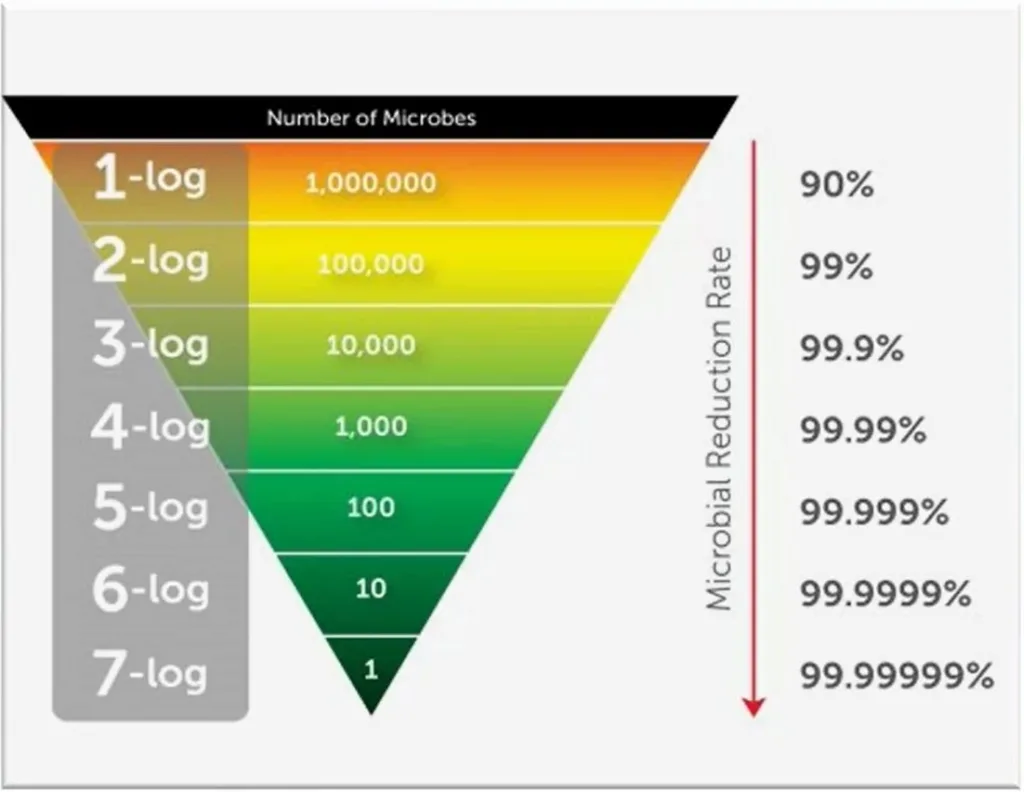
Log reduction is a logarithmic (base 10) scale measuring how effectively a process reduces microorganisms. Each "log" represents a tenfold reduction. A 1-log reduction = 90% kill, 2-log = 99%, 3-log = 99.9%.
How do I calculate log reduction?
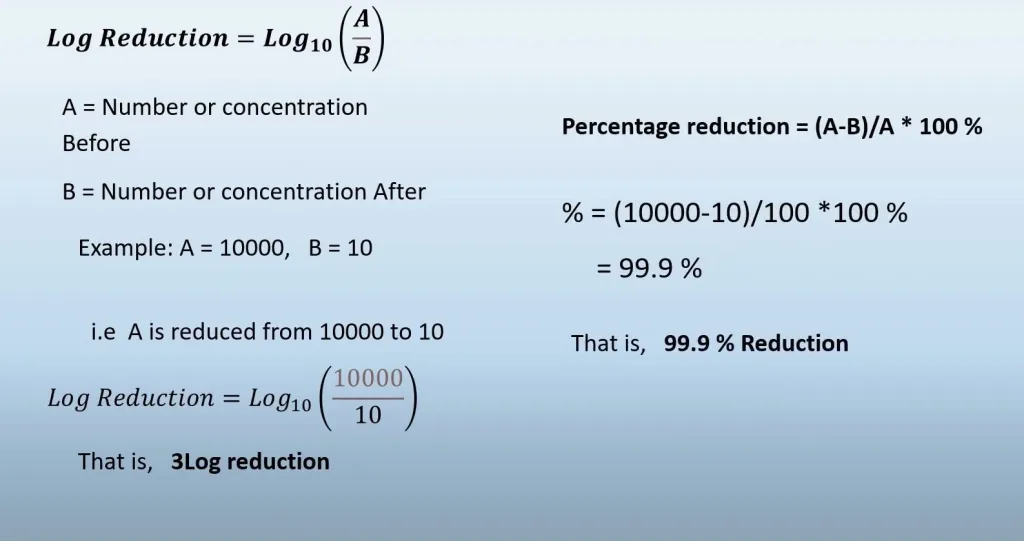
Use the formula:
Log Reduction = log₁₀(Initial CFU ÷ Final CFU)
Example: 1,000,000 bacteria reduced to 100 = log₁₀(10,000) = 4-log reduction.
What does a 1-log reduction mean?
A 1-log reduction = 90% reduction in microbes (10% survive). Example: 10,000 bacteria → 1,000 bacteria remaining. Survival rate is 1 in 10.
What is a 3-log reduction equivalent to?
A 3-log reduction = 99.9% reduction (0.1% or 1 in 1,000 survive). EPA requires 3-log removal for Giardia cysts in drinking water treatment.
What is a 4-log reduction?
A 4-log reduction = 99.99% reduction (1 in 10,000 survive). EPA requires 4-log removal for viruses in surface water treatment. Also the minimum standard for instrument disinfection per European standards.
What is a 5-log reduction?
A 5-log reduction = 99.999% reduction (1 in 100,000 survive). Considered high-level disinfection, commonly required in pharmaceutical manufacturing, food processing, and medical device disinfection.
What is a 6-log reduction?
A 6-log reduction = 99.9999% elimination (1 in 1,000,000 survive). Required for surgical instruments in healthcare settings. EPA standard for hospital disinfection requires ≥6-log reduction in ≤10 minutes.
What is the difference between log reduction and percent reduction?
Log reduction uses logarithmic scale while percent uses linear scale. Log scale better shows large differences: 3-log (99.9%) vs 6-log (99.9999%) look similar as percentages, but 6-log actually kills 1,000 times more microbes.
Why is log reduction used instead of percentage?
Microbial populations span multiple orders of magnitude (thousands to billions). Logarithmic scale makes large numbers manageable and easier to compare. It also follows the exponential nature of microbial death during disinfection.
What is CFU in microbiology?
CFU = Colony Forming Unit. It's the number of viable microorganisms that can form visible colonies on growth media. Used instead of cell counts because not all cells form colonies, and some CFUs contain multiple clumped cells. Measured as CFU/mL or CFU/g.
What is the difference between sterilization and disinfection in terms of log reduction?
Sterilization requires 12-log reduction (SAL of 10⁻⁶), eliminating all microorganisms including bacterial spores. Disinfection achieves 3-6 log reduction, significantly reducing but not eliminating all microbes. Sterilization for medical devices; disinfection for water treatment and surfaces.
What log reduction is required for drinking water treatment?
EPA standards require 4-log reduction (99.99%) for viruses and 3-log reduction (99.9%) for Giardia cysts in surface water treatment. These removals (filtration + disinfection) ensure safe drinking water.
Can log reduction be negative?
Yes, negative log reduction occurs when microorganisms increase after treatment instead of decreasing. This indicates failed disinfection or microbial growth occurred, which is undesirable and means treatment was ineffective.
What is the formula to convert log reduction to percentage?
Formula:
Percent Reduction = (1 - 10⁻ᴺ) × 100
where N = log reduction. Example: 3-log = (1 - 10⁻³) × 100 = 99.9%. The number of nines equals the log value for whole numbers.
What is Sterility Assurance Level (SAL)?
SAL = Sterility Assurance Level, the probability one item remains non-sterile after sterilization. Standard is 10⁻⁶ (1 in 1,000,000 chance). Different from log reduction: SAL = survival probability per spore; log reduction = total population reduction. Achieving 10⁻⁶ SAL from 1 million spores needs 12-log reduction.
How do you measure initial and final microbial counts?
Samples are collected before/after treatment, diluted through serial dilution, and plated on growth media. After incubation, visible colonies are counted as CFU per volume/weight using the dilution factor. Modern methods include automated counters or molecular techniques.
What factors affect log reduction in water disinfection?
Key factors: disinfectant concentration, contact time, temperature, pH levels, turbidity, organic matter, microorganism type, and flow patterns. All must be optimized for desired log reduction.
What industries use log reduction calculations?
Healthcare (surgical instruments), water treatment (drinking water safety), food/beverage (pasteurization), pharmaceutical (sterility), cosmetics (preservative testing), laboratories (protocol validation), aquaculture (disease prevention), environmental remediation (pathogen removal).
What is D-value in sterilization?
D-value = Decimal Reduction Time, the time for 1-log reduction at specific temperature. Example: D₁₂₁ = 2 minutes means 2 minutes at 121°C for 90% kill. A 6-log reduction needs 6 × 2 = 12 minutes. D-values are microorganism-specific.
Why is 12-log reduction required for sterilization?
12-log reduction achieves SAL of 10⁻⁶: (1) 6-log to reduce 1 million spores to 1, plus (2) 6-log more for 1-in-1-million survival probability. Provides highest sterility assurance for critical medical devices and injectable pharmaceuticals.
What is the relationship between CFU counting and serial dilution?
Serial dilution reduces high populations to countable levels (25-250 colonies/plate). Sample is diluted sequentially (e.g., 1:10) until countable. CFU/mL = colony count × dilution factor reciprocal. Example: 50 colonies at 10⁻⁵ dilution (0.1 mL) = 50 × 10⁵ ÷ 0.1 = 5 × 10⁷ CFU/mL.
What is CT value in disinfection?
CT value = Concentration (mg/L) × Time (minutes). Measures chemical disinfection effectiveness. Different organisms need different CT values. Example: chlorine needs 3-4 mg·min/L for 2-log E. coli reduction, but 15-150 mg·min/L for Giardia. Higher CT = greater reduction.
How is log reduction validated in practice?
Uses biological indicators with known populations of resistant organisms (e.g., Geobacillus stearothermophilus spores for steam). Indicators are exposed to the process, then cultured for survival. If required log reduction of resistant organisms is achieved, process is validated. Multiple replicates tested.
What is the difference between log removal and log inactivation?
Log removal = physical removal (filtration). Log inactivation = killing/deactivating (disinfection). Both contribute to total log reduction. Example: filtration provides 2-3 log removal of Giardia + chlorination adds 0.5-1 log inactivation = 2.5-4 total log reduction.
Why are different microorganisms harder to kill?
Resistance order (least→most): vegetative bacteria, fungi, non-enveloped viruses, mycobacteria, bacterial spores. Factors: cell wall thickness, spore coats, enzymatic defenses, biofilm formation, DNA repair. Sterilization processes validated against most resistant organisms.
What is the Most Probable Number (MPN) method and how does it relate to CFU?
MPN (Most Probable Number) is an alternative to CFU, useful for low concentrations or particulate samples. Serial dilutions inoculated in liquid media tubes; growth pattern statistically estimates concentration. Common in water quality testing for coliforms. CFU = actual count; MPN = statistical estimate.
How does bioburden affect sterilization requirements?
Bioburden = viable microorganisms on product before sterilization. Higher bioburden needs longer/more intense sterilization. Cleaning reduces bioburden 2-6 log. Example: device with 10⁶ bioburden needs 12-log reduction; if cleaned to 10² needs only 8-log for same 10⁻⁶ SAL.
What are the limitations of log reduction calculations?
Limitations: assumes uniform distribution, doesn't account for clumped cells, only measures viable/culturable organisms, different media give different counts, dilution/plating errors accumulate, statistical variation at extreme concentrations. Despite limitations, remains industry standard.
How do UV-C systems achieve log reduction?
UV-C light (254 nm) damages microbial DNA/RNA, preventing replication. Each organism needs specific UV dose (mJ/cm²) for different log reductions. Example: E. coli needs ~6.6 mJ/cm² for 4-log; resistant organisms like Cryptosporidium need higher doses. Dose = intensity × time.
What is high-level disinfection and what log reduction does it achieve?
High-level disinfection (HLD) kills all microbes except high numbers of bacterial spores. Achieves 4-6 log reduction. Used for semi-critical devices (contact mucous membranes, e.g., endoscopes). Uses glutaraldehyde, OPA, or peracetic acid. Between sterilization and low-level disinfection.
Important Note: Log reduction requirements vary by application, regulatory jurisdiction, and type of microorganism. Always consult relevant standards and regulations (EPA, FDA, WHO, CDC) for specific requirements in your industry or application.