Chimneys are made to safely release the smoke from the industry to disperse them into the air. However, the released smoke covers some additional height before it takes the form of a smoke plume.
CLICK: EXCEL DESIGN SHEET (CALCULATE)

The various parameters which make the modeling of a plume complex include:
- Exit velocity
- Wind speed
- Diameter of chimney at exit
- Temperature of Plume
- Air turbulence
- Air quality
- Air moisture
- Terrain
- Cumulative effects
Several mathematical models have been developed to develop the dispersion model. The popular one is that smoke follows Gaussian concentration distribution.
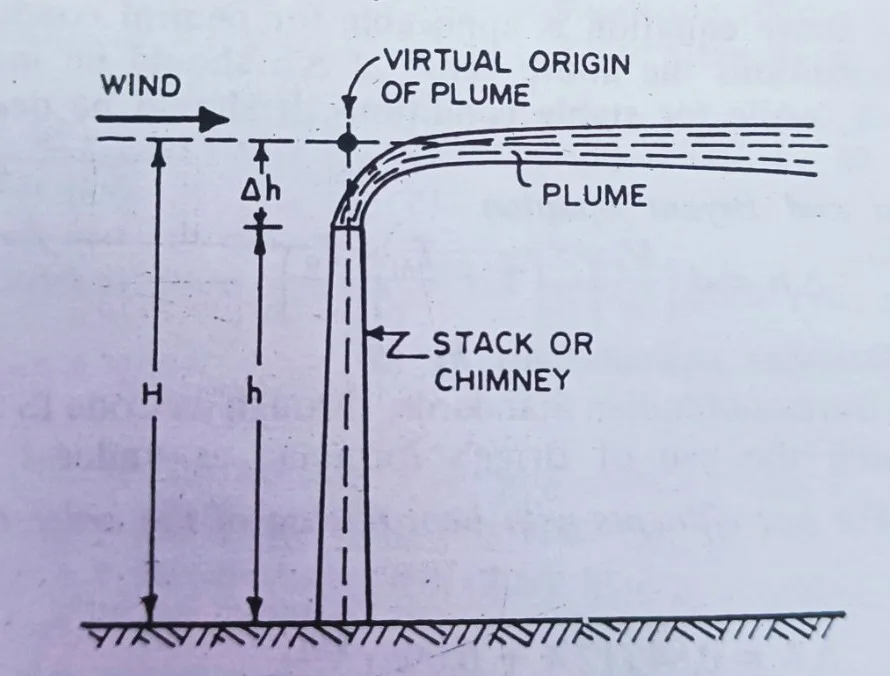
- H is the effective height of the chimney
- Δ h is the plume height
- h is the physical height of the chimney
Plume height calculation: Holland Equation
Hollands equation is often used for the determination of the plume height from chimneys,

- Δ h = Plume height (meter)
- Vs = Stack exit velocity (m/s)
- u = wind speed (m/s)
- d = diameter of stack at exit (m)
- p = atmospheric pressure in millibars
- Ts = Stack gas temperature (Degree Kelvin)
- Ta = Air temperature (Degree Kelvin)
The above is for neutral conditions. The value for Δ h can be increased by 10 to 20% for unstable conditions and decreased by the same for stable conditions.
…
Example 1: Determine the effective height of a stack (h), with the following parameters
- The physical stack is 200 meters tall with 1.00 meters diameter
- Wind velocity is 3.00 m/s
- Air temperature is 20 degrees Celsius
- Barometric pressure is 1000 millibars
- Stack gas velocity is 11.5 m/s
- Stack gas temperature is 150 degrees Celsius
SOLUTION:
- Δ h = Needed to be calculated?
- Vs = 11.5 m/s
- u = 3 m/s
- d = 1.00 m
- p = 1000 millibars
- Ts = 150 Degree Celsius = (273+150) Degree Celsius = 423 Degree Celsius
- Ta = 20 Degree Celsius = (273+20) Degree Celsius = 293 Degree Celsius
Using Holland’s equation,

Plume height (Δ h) = 8.90 meter
The effective height of the stack is (H) = h + Δ h = 200 + 8.9 = 208.9 meters
Hence, the smoke will plume/trail at 208.9 meters from the ground level.

…
Example 2: Determine the Physical height of the Chimney and the smoke plume height with the following available data
- Factory Capacity: 2400 tonnes of coal with a sulfur content of 4.2% burned per day
- Diameter of the stack to be used = 8 meter
- Gas exit velocity = 18.3 m/s
- Temperature of gas released = 140 degrees Celsius
- Ambient air temperature = 8 degrees Celsius
- Atmospheric pressure = 1000 millibars
- Average wind speed = 4.5 m/s
SOLUTION:
The physical height of the chimney = ?
The plume height = ?
The effective height of the chimney = ?
Using Holland’s equation

Plume height (Δ h) = 271.73 meter
Now, the physical height of the chimney is given by a formula prescribed by Indian standards as:
Physical height of chimney = 14 (Qs))0.3, where Qs is SO2 consumed in kg/hour
Let’s assume the factory runs for 12 hours daily, using 24000 tonnes of coal. Then,
Emission rate of Sulphur = 2400/12 *1000*0.042 = 8400 kg/hour
Sulfur in coal combines with oxygen to form SO2,
S ( 8400 Kg ) + O2 ( 8400 Kg ) ———–> SO2 (16800 Kg )
Emission rate of SO2 (Qs) = 16800 Kg/hour
Minimum Height of Chimney required = 14 (Qs)0.3 = 14 (16800)0.3 = 259.3 meters
Hence, the minimum height of a physical chimney needs to be 260 meters.
The effective height of the Chimney will be (H) = 260 + 271.7 = 531.7 meter

…
Now that we know the height to which the smoke rises, the next step is to determine its impact on air quality at ground level. Additionally, there will be a point where the smoke’s effect is most concentrated. To know this:
READ: “Calculate Air Quality Near a Chimney.” (Part 3)
To calculate the physical height of the Chimney required:
READ: “Simple Height calculation of Chimney for industries” (Part 1)