Reverse osmosis commonly called RO is a water purification technology that is in simple terms a membrane filtration technology. The water passes through a very fine membrane (size in nanometers) through the application of water pressure which is applied through motors.
There are hundreds of products available in the market for RO. But, the main question is:
“DO YOU EVEN NEED A RO FILTER IN YOUR HOUSE?”
RO filter has its advantages and disadvantages. The major disadvantages of RO filter are:
- High initial cost
- High water wastage (Common filter: 4 liters of water wasted for 1 liter of filtered water)
- Long time to filter (Common filter: 7 minutes for 1 liter filtered water)
- Electricity consumption (Common filter: 60 watts)
- Needs timely repair and maintenance
Only calculating the water and electricity consumption in a month for 5 people using 40 liters of water daily for drinking and cooking.
- Water Wasted in a month: 4800 liters (can be reused for other purposes)
- Power consumed in a month: 8.4 KWH (8.4 units of electricity)
Yet, the RO filter offers a point-of-use filtration device. The RO is not used standalone but is combined with prefiltration, ultrafiltration, and UV disinfection after filtration. The prefilration is essential to reduce the load in the RO filter membrane.
A person needs to clean drinking water which does not mean that it should not contain any impurities. The minerals are needed for our body which we also get from the drinking water along with the food that we eat.
The WHO and other country standards specify those limits. In Nepal National Drinking Water Quality Standards (NDWQS) specify the drinking water quality standards which nearly also match the WHO standards.
Below, is a test report of the water from my house. I have tested it for a total of 17 drinking water parameters and all the parameters are within the limits. Then, what am I purifying water for?
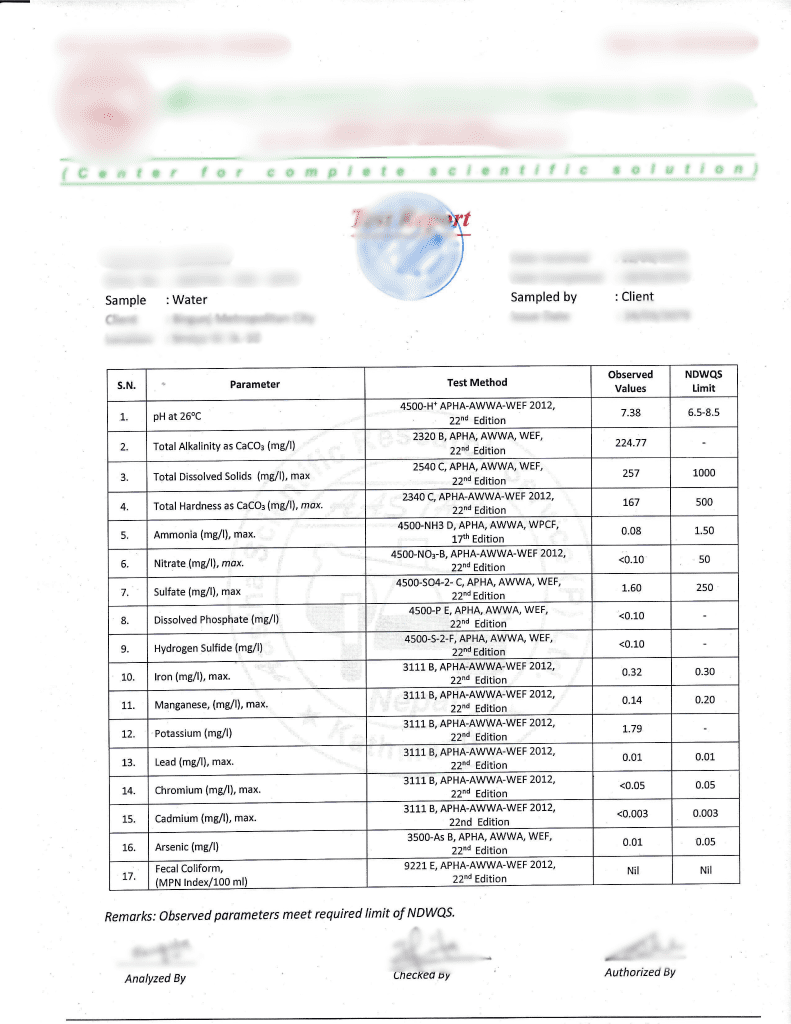
All parameters are okay. There is no need to purify the already pure water. Am I wasting useful resources? I think that the answer to that is a mixed one.
Yes, it is a waste of resources to fix and operate a RO filter. However, the water quality does vary from time to time as I am extracting the groundwater through suction pumps. I cannot know the exact water quality. Thus, the RO filter gives me the same quality of water and protection from harmful pathogens.
I still think that the RO filter is a waste of resources. Only the UV filter will work and the RO filter set is a waste of money if the water quality is consistently within the quality standards. The Ultraviolet light (UV) device will kill the bacteria if it is present at the point of use in house.
CONCLUSION
If the water quality is good there is no chance that the water quality will differ much. Chlorination or using a UV filter will work best and there is no need to install a RO filter unit.
Rakesh Shah (Civil and Environmental Engineer)
Author